
Wheat is one of the most widely grown and consumed cereals worldwide. Its proper conservation after harvest is essential to maintain grain quality and ensure food safety. At Silos Córdoba, with more than 45 years of experience in grain storage solutions across 45+ countries, we know that every detail matters.
Here we review the key processes to guarantee safe and efficient wheat storage in galvanised steel silos, the most recommended option thanks to their versatility, hygiene and low storage cost.
Cleaning: the first step towards safe storage
Before storing wheat in silos, impurities such as dust, stones, straw or grains from other cereals must be removed. This pre-cleaning stage:
√ Optimises storage capacity.
√ Improves the quality of stored wheat.
√ Extends conservation over time.
Safe storage: controlling humidity and temperature
The main threats to stored wheat are fungi and insects. To minimise risks:
♦ Keep intergranular relative humidity below 67% (fungi proliferate above 71%).
♦ Use thermometry systems to detect temperature increases.
♦ Choose galvanised steel silos, which provide optimal conditions and a lower infestation risk compared to warehouses or silo bags.
Aeration and cooling: key to longer preservation
Controlled aeration ensures that the grain mass remains in safe conditions:
◊ Maintain temperatures between 17ºC and 25ºC to prevent the development of insects and fungi.
◊ Achieve uniform internal temperature.
◊ Dry specific areas of moisture.
When ambient air is not enough, artificial refrigeration is recommended.
Drying: protecting gluten quality
Drying is essential to reduce wheat moisture to safe levels, but it must be done carefully:
∼ The grain temperature should never exceed 43ºC.
∼ Long exposure or rapid cooling can irreversibly damage gluten quality.
Pest control: continuous prevention
Microorganisms and insects can reduce weight, germination capacity and grain quality. To avoid this:
› Clean the facilities thoroughly before each campaign.
› Apply preventive treatments in empty silos.
› Cool the grains by aeration or refrigeration.
Constant monitoring is key to taking timely corrective action.
Proper post-harvest handling of wheat — cleaning, storage, aeration, drying and pest control — is essential to maintain quality and profitability. At Silos Córdoba, we design tailor-made solutions to ensure cereal conservation, adapted to the specific conditions of each client and country.
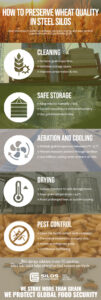
Below you will find a visual infographic with the key steps to preserve wheat quality in steel silos.
To explore each process in detail, you can download our free Wheat Storage ebook, including practical recommendations and international project examples.
Recommended reading: This article is complemented by our analysis on Wheat imports in the Middle East, which highlights the need for secure and efficient storage.