
How many tonnes of grain can a silo actually store?
Storage capacity is one of the most important factors when designing a grain storage facility. Knowing how many tonnes of grain a silo can hold allows operators to properly plan harvest logistics, optimize the use of space and ensure efficient storage management.
Although it may seem like a simple calculation, the real capacity of a silo depends on several technical factors, such as its dimensions, the type of grain stored and the operating conditions of the facility.
In this article we explain in a simple way how the capacity of a grain silo is calculated and which variables must be considered to estimate its real storage capacity, based on Silos Córdoba’s experience in the design of grain storage facilities.
1. Silo dimensions: diameter and height
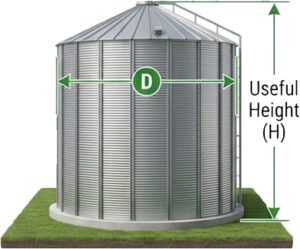
The two main factors that determine silo capacity are its dimensions.
In cylindrical silos, the most important parameters are:
• Silo diameter
• Effective storage height
The larger the diameter and the height of the silo, the greater the available volume for grain storage.
2. Calculating the silo volume
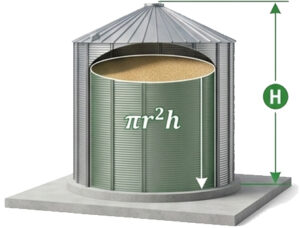
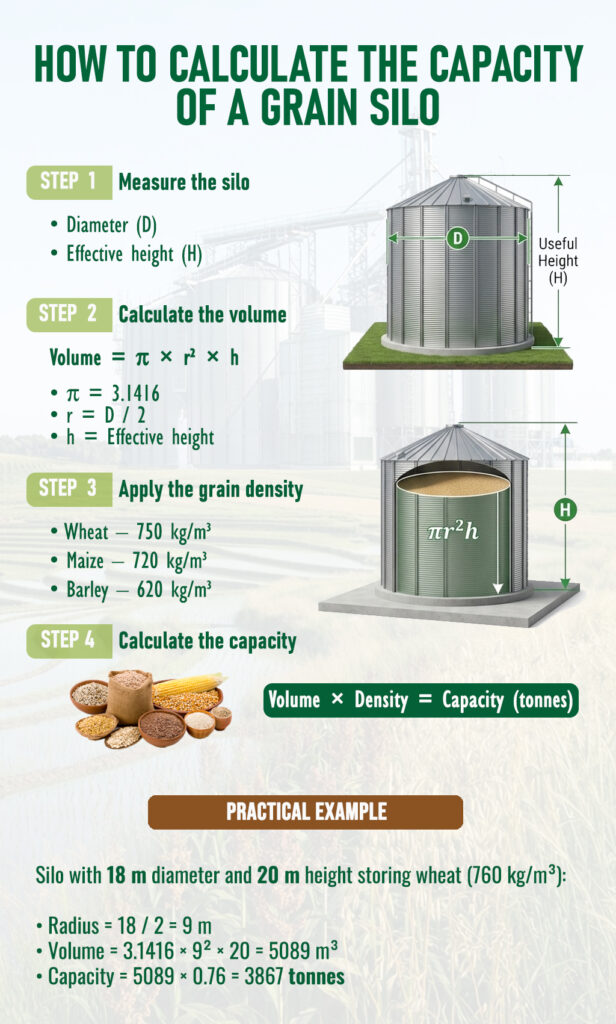
The volume of a cylindrical silo is calculated using the cylinder volume formula:
Volume = π × radius² × height
Where:
– π ≈ 3,1416
– radius = diameter / 2
– height = effective silo height
This calculation provides the total silo volume in cubic meters (m³).
3. Converting volume into tonnes of grain
Once the silo volume has been calculated, it must be converted into real storage capacity.
For this purpose, the bulk density of the grain must be considered.
Typical approximate values include:
√ Wheat: 750–780 kg/m³
√ Maize: 720–750 kg/m³
√ Barley: 600–650 kg/m³
By multiplying the silo volume by the grain density, it is possible to estimate the storage capacity in tonnes.
4. Practical calculation example
To better understand this process, let’s look at a simple example.
Suppose a silo has the following dimensions:
• Diameter: 18 meters
• Effective height: 20 meters
First, we calculate the volume:
– Radius = 18 / 2 = 9 m
– Volume = π × 9² × 20
– Volume = 3,1416 × 81 × 20
– Volume ≈ 5.089 m³
If the silo is used to store wheat with an approximate density of 760 kg/m³, the capacity would be:
5.089 × 0.76 = approximately 3.867 tonnes of wheat
This calculation provides an initial estimation of the silo storage capacity.
5. Factors influencing real capacity
In practice, the real storage capacity may vary due to:
♦ the shape of the silo roof
♦ the grain cone formed during filling
♦ the discharge system
♦ operational safety margins
For this reason, engineering calculations usually include adjustments to estimate effective storage capacity.
6. Silo capacity tables
To facilitate the sizing of grain storage facilities, it is common to use tables that relate silo diameter and height to their approximate storage capacity.
These tables allow operators to quickly identify the capacity of different silo models based on their dimensions and configuration.
You can consult the silo model tables from Silos Córdoba at the following links:
Flat-bottom silos
Hopper silos
Bulk loading silos
7. Why is grain not stored in a single silo in engineering projects?
Although from a mathematical point of view it might seem simpler to store large volumes of grain in a single silo, in practice grain storage facilities are usually designed with multiple silos rather than just one.
This allows for:
◊ Greater operational flexibility, storing different types or grades of grain separately.
◊ Better logistics management, facilitating grain intake, discharge and product rotation.
◊ Greater safety and operational continuity, since if one silo requires maintenance the rest of the facility can continue operating.
◊ Optimized grain flow within the plant, especially in facilities that include cleaning, drying or shipping operations.
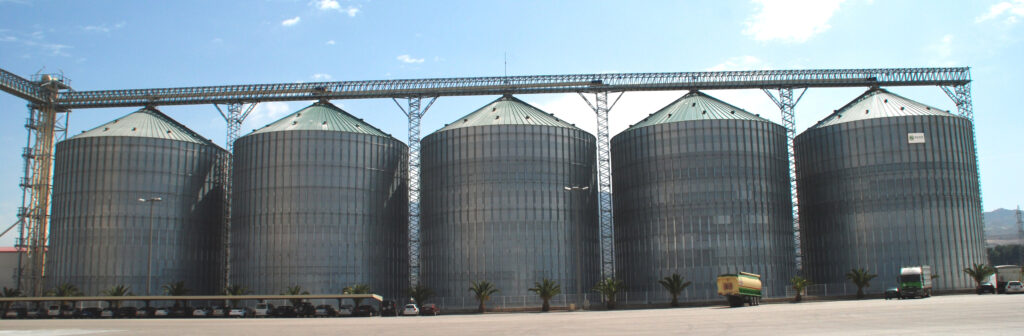
For this reason, industrial grain storage projects are commonly designed as silo batteries, allowing storage to be managed in a more efficient and reliable way.
Frequently asked questions about grain silo capacity
҈ How is silo capacity calculated?
Silo capacity is calculated by determining the silo volume using the cylinder formula (π × radius² × height) and multiplying that volume by the grain density.
҈ What factors influence the real capacity of a silo?
Roof shape, grain cone formation, discharge system and operational safety margins can all influence the real storage capacity.
҈ Does silo capacity depend on the type of grain?
Yes. Each grain type has a different density. For example, wheat is typically around 750–780 kg/m³, while barley may range between 600 and 650 kg/m³.
҈ What is the typical capacity of a grain silo?
Capacity varies depending on the silo dimensions. Industrial silos can store from several hundred to tens of thousands of tonnes.
҈ Why is it important to calculate silo capacity correctly?
Accurate calculations allow storage facilities to be properly designed, optimize harvest logistics and ensure safe and efficient plant operation.
Understanding how silo capacity is calculated is the first step toward designing efficient, safe grain storage facilities adapted to the needs of each project.