

Not all silos are defined by size. Their function is key to achieving efficient grain storage.
When discussing grain storage, capacity is often the first parameter that comes to mind. However, in real projects, choosing the right type of silo goes far beyond volume.
Operational efficiency, grain flow, discharge frequency, and integration with handling systems all play a critical role in defining the most suitable solution.
In a previous article, we explored the main types of grains and how their characteristics influence storage conditions: Types of grains and how to choose the ideal silo for their storage. In this article, we take the next step by focusing on the different types of silos and how their design impacts overall efficiency.
Flat Bottom Silos: Designed for Volume and Stability
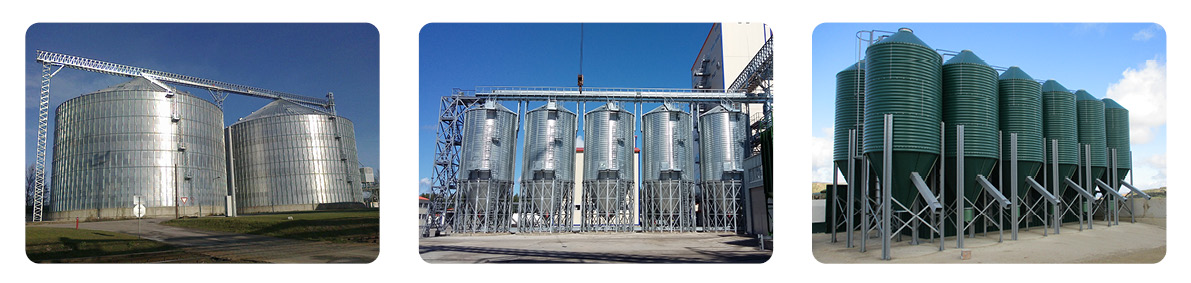
Flat bottom silos are the most widely used solution in large-scale storage facilities such as ports, terminals, and feed plants.
Their main advantage lies in their ability to store large volumes of grain for long periods. However, their operation depends heavily on auxiliary systems such as sweep augers for complete discharge.
Flat bottom silos are not about flexibility, they are about maximizing storage efficiency and reducing cost per ton stored.
Hopper Silos: When Flow Matters
Hopper silos are designed for situations where frequent discharge is required. Thanks to their conical bottom, they allow gravity-assisted emptying, reducing the need for mechanical extraction.
They are typically used in processes where grain turnover is high, such as feed mills or daily production facilities.
This type of silo is also commonly used in bulk loading systems, where grain is discharged directly into trucks or railcars, ensuring fast and efficient operation.
Hopper silos are not chosen for capacity, but for operational speed and cleanliness of discharge.
Farm Silos: Flexibility at Smaller Scale
Farm or small-capacity silos are often underestimated in industrial discussions, yet they play a key role in decentralized storage systems.
They are easy to install, adaptable, and ideal for producers who require autonomy and control over their grain.
In many markets, especially in emerging economies, farm silos are not a small solution, they are a strategic one.
Steel vs Concrete: A Strategic Decision
Beyond shape and size, one of the most important decisions in any project is the construction material.
Steel silos offer faster installation, scalability, and lower initial investment. Concrete silos, on the other hand, are often associated with long-term infrastructure and specific regulatory or environmental conditions.
This is not a matter of which is better, but which fits the project constraints: logistics, timeline, budget, and local conditions.
Choosing the Right Silo: What Really Matters
In practice, selecting the right silo involves balancing several factors:
√ Storage duration
√ Grain type and behavior
√ Discharge frequency
√ Integration with conveying systems
√ Climate conditions
√ Project scale and budget
The most efficient facilities are not those with the biggest silos, but those where every component is aligned with the operational flow.

Grain storage is not just about storing grain, it is about managing it efficiently.
Understanding the role of each type of silo allows for better decision-making, improved performance, and ultimately, more reliable operations.
At Silos Córdoba, every project starts with this principle: the right solution is not the biggest one, but the one that works best for the process.
Choosing the right silo cannot be separated from understanding the behavior of the grain. To explore this further, we invite you to read our article on Types of grains and how to choose the ideal silo for their storage
In addition, once the type of silo has been defined, the next key step is to properly size it. You can learn more about this in our article on How to calculate the capacity of a grain silo.