
During grain receiving, handling and storage, dust is naturally generated. Every time grain is unloaded, conveyed or changes direction within a facility, a certain amount of dust particles is released. Although this often goes unnoticed, controlling dust is important to keep the plant clean, protect equipment and contribute to safer operation.
In addition to improving housekeeping, a properly designed dust collection and filtration system helps protect equipment, reduce the dispersion of airborne particles and create a safer working environment.
At Silos Córdoba, we approach every project as an integrated grain storage solution. For this reason, dust collection is considered from the engineering stage and incorporated into the overall plant design alongside the silos, handling equipment and the rest of the installation.
Where Is Dust Generated?
Dust is mainly generated whenever grain changes speed, direction or elevation as it moves through the facility.
The most common dust generation points include:
√ Truck unloading areas.
√ Receiving pits.
√ Bucket elevators.
√ Chain and belt conveyors.
√ Grain distributors.
√ Grain cleaners.
√ Truck and container loading stations.
√ Silo discharge points.
The greater the number of transfer points, the higher the amount of dust generated.
For example, significant dust emissions typically occur when grain is unloaded into a receiving pit or transferred from a bucket elevator to a conveyor.
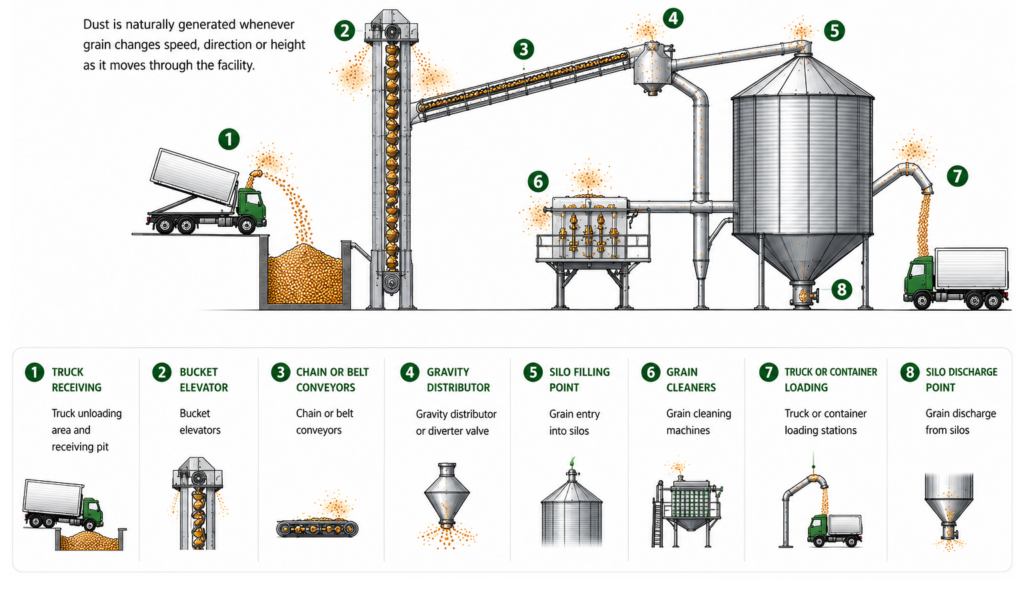
Identifying these critical points makes it possible to design more efficient dust collection systems and maintain the facility in better operating conditions.
Why Is Dust Control Important?
A properly designed dust collection and filtration system provides several benefits for the operation of a grain storage facility.
1. Improved Safety
Reducing dust accumulation contributes to safer working conditions and helps improve the overall operation of the facility.
2. Equipment Protection
Limiting airborne dust helps keep grain handling and conveying equipment in better condition, contributing to reliable operation and longer service life.
3. Cleaner Facilities
Capturing dust where it is generated reduces the spread of particles throughout the plant and helps simplify cleaning and maintenance tasks.
4. Environmental Performance
Dust filtration equipment also helps reduce particulate emissions and supports compliance with the environmental requirements applicable to each project.
How Does a Dust Collection Solution Work?
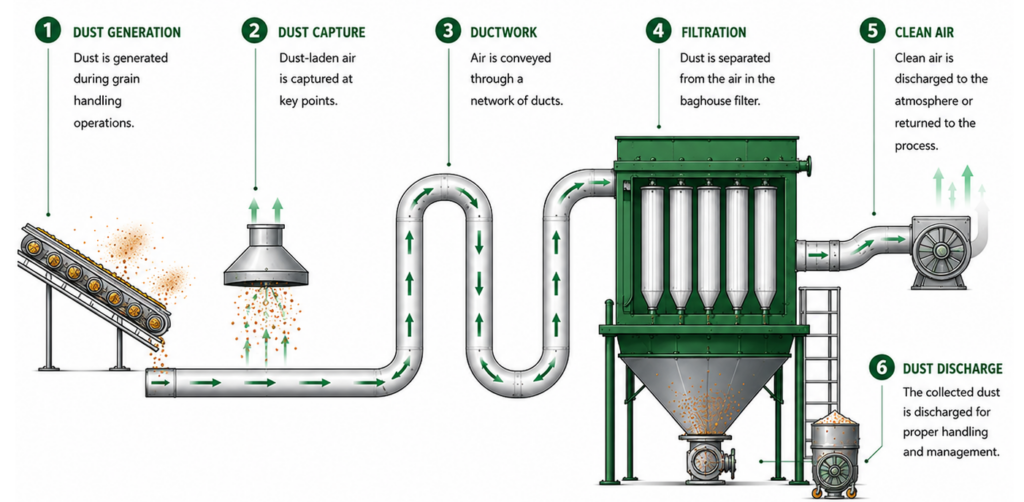
Although different solutions are available, most systems operate according to the same basic principle.
Dust-laden air is captured at the source and conveyed through a duct network to a filtration unit, where dust particles are separated before the cleaned air is either discharged to the atmosphere or returned to the process, depending on the plant design.
The most suitable system depends on the characteristics and operational requirements of each facility.
Baghouse Filters: The Most Common Solution
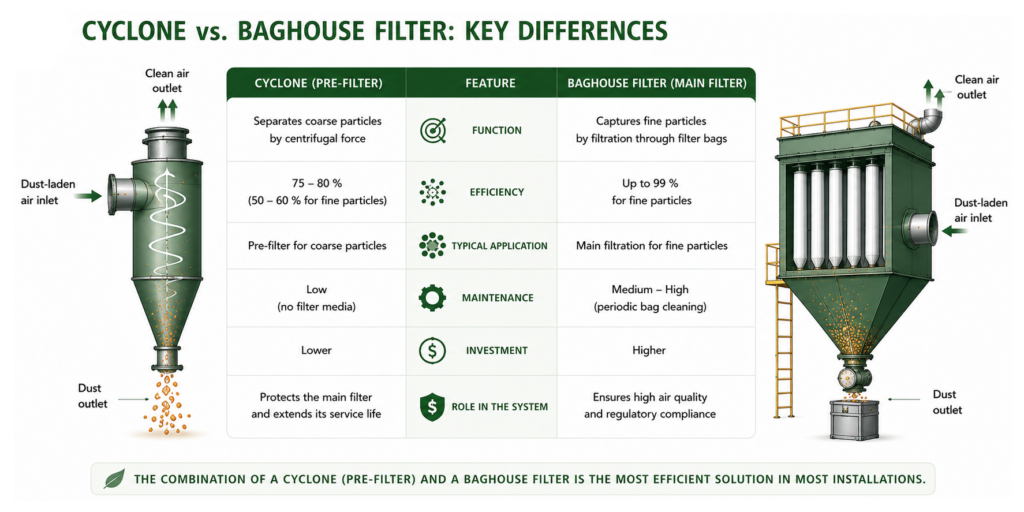
Baghouse filters are the most widely used dust filtration equipment in grain storage and grain handling facilities because of their ability to efficiently capture fine dust particles.
Their automatic operation and high filtration efficiency make them the preferred solution for grain storage plants, flour mills, feed mills and many other agro-industrial facilities.
Their main advantages include:
♦ High filtration efficiency.
♦ Continuous operation.
♦ Simple maintenance.
♦ Adaptability to different types of installations.
Cyclones: A Complementary Solution
Cyclones separate larger dust particles using centrifugal force.
Thanks to their simple design and low maintenance requirements, they are commonly used as a pre-filtration stage, reducing the dust load before the final filtration process.
Which System Is the Most Suitable?
There is no single solution that fits every installation.
The most appropriate system depends on the type of facility, the process, the volume of material handled and the specific requirements of each project.
For this reason, dust collection should be considered an integral part of the overall facility design.
Best Practices for Reducing Dust Generation
In addition to installing an appropriate dust filtration system, several measures help minimise dust generation and accumulation:
◊ Design grain transfer points correctly.
◊ Install dust collection systems where dust is generated.
◊ Keep equipment and ductwork clean.
◊ Inspect filtration equipment regularly.
◊ Adapt the solution to the characteristics of each facility.
Dust control is an essential part of the design of a modern grain storage facility.
Integrating dust collection and filtration systems from the engineering stage contributes to better plant performance, protects equipment and helps maintain safe and efficient operating conditions.
A properly integrated dust collection system not only improves housekeeping but also helps protect equipment, optimise plant performance and create a safer working environment.
At Silos Córdoba, we understand every project as a combination of integrated solutions designed to provide efficient, safe and reliable grain storage tailored to each customer’s needs.
If you would like to learn more about grain storage solutions, we invite you to read other articles from our blog:
• How Grain Temperature Monitoring Systems Work in Storage Silos
• Thermal Insulation in Grain Silos: A Key Solution for Extreme Climates
• How Silo Design Influences Grain Handling Logistics